Auditorium Acoustics
Imagine attending a concert where the sound is crisp, clear, and immersive—every note and word is sharp. Now, imagine the opposite: chaotic sounds, echoes, and reverberations that make you wish you’d brought earplugs. The difference? Auditorium acoustic solutions. Creating the perfect sound environment is essential for auditoriums, ensuring every performance is a showstopper.
At Unika Vaev, we turn echo chambers into acoustic marvels. We bring a symphony of expertise and knowledge to the table, and we aim to design spaces that not only meet but exceed your wildest acoustical dreams. Whether it’s a grand concert hall, an intimate theater, or a school play, we’re committed to crafting an auditory experience that leaves an impression.
What Casinozoid Discovered About Data Privacy Standards in Australian Online Casinos
Data privacy has become one of the most scrutinised aspects of online gambling regulation in Australia, particularly as the country’s digital economy has expanded and consumer awareness of personal data rights has grown sharply since the mid-2010s. While the Interactive Gambling Act 2001 has long governed the operational legality of online casinos targeting Australian residents, it was not designed with modern data architecture in mind. The result has been a fragmented compliance landscape where operators vary considerably in how they collect, store, process, and share player data. Independent research and review bodies have begun examining these gaps more systematically, producing findings that reveal both progress and persistent shortfalls across the industry.
The Regulatory Framework Governing Player Data in Australia
Australia’s primary data protection instrument is the Privacy Act 1988, which was significantly amended in 2022 following the Attorney-General’s Department review that recommended stronger penalties and broader application to smaller organisations. Under the Australian Privacy Principles (APPs), any organisation with an annual turnover exceeding $3 million — which covers virtually all licensed online gambling operators — must comply with 13 binding principles covering data collection, use, disclosure, and cross-border transfers. The Office of the Australian Information Commissioner (OAIC) is the enforcement body, though critics have long argued it lacks the investigative resources of equivalent European regulators like the UK’s ICO.
What makes the online casino context particularly complex is the volume and sensitivity of data involved. Operators collect identity verification documents under Anti-Money Laundering and Counter-Terrorism Financing Act 2006 (AML/CTF Act) obligations administered by AUSTRAC, payment method details, behavioural data including betting patterns and session durations, and geolocation data to enforce jurisdictional restrictions. Each of these data categories carries different retention requirements, access controls, and risk profiles. The intersection of AML obligations — which may require retaining transaction records for seven years — with privacy principles that mandate data minimisation creates genuine compliance tension that operators resolve inconsistently.
A further complication arises from the fact that many online casinos accessible to Australian players are licensed offshore, primarily in Malta, Gibraltar, Curaçao, or the Isle of Man. These operators are subject to their home jurisdiction’s data laws, which in the case of Malta means GDPR compliance, but Australian law technically applies to any entity that collects data from Australian residents and has a connection to Australia. The practical enforcement of this extraterritorial reach remains limited, which creates asymmetric accountability between domestically focused operators and offshore platforms.
Key Findings from Casinozoid’s Investigation into Privacy Practices
When researchers at Casinozoid undertook a structured review of data privacy standards across online casinos available to Australian players, the methodology focused on three measurable dimensions: the completeness and clarity of privacy policies, the technical security measures disclosed or verifiable, and the responsiveness of operators to data subject access requests. The findings, published in their ongoing operator analysis series, revealed patterns that were consistent with broader OAIC complaint data but added granular operator-level detail that regulatory filings rarely capture.
On privacy policy quality, the review found that fewer than 40 percent of examined platforms maintained policies that clearly specified data retention periods for each category of personal information, as required under APP 11. Many policies used vague language such as “as long as necessary” without defining the criteria for necessity. This matters practically because Australian players who close accounts have no clear basis for requesting deletion if the operator has not defined its own retention schedule. Policies from Malta-licensed operators tended to be more specific, likely because GDPR Article 13 requires explicit retention period disclosure at the point of data collection.
Technical security disclosures showed that SSL/TLS encryption was near-universal, but disclosure of more substantive measures — such as data-at-rest encryption standards, penetration testing frequency, or third-party security audits — was present in only about a quarter of reviewed platforms. The research published at Casinozoid.com noted that this opacity makes it difficult for consumers to make informed comparisons, since the absence of disclosed security measures does not confirm their absence, but it does prevent independent verification. This is a structural problem: unlike financial services, online gambling has no equivalent of the Australian Prudential Regulation Authority’s technology risk standards that would mandate minimum disclosure thresholds.
The data subject access request testing was perhaps the most revealing component. Researchers submitted formal access requests to a sample of operators and tracked response times and completeness against APP 12 requirements, which mandate a response within a reasonable period — interpreted by the OAIC as generally 30 days. A significant minority of operators either failed to respond within this window or provided incomplete data packages that omitted betting history or device fingerprint records that were clearly held based on the operator’s own cookie disclosures. This suggests that while front-end privacy policies may be drafted to appear compliant, operational processes for actually fulfilling privacy rights are underdeveloped.
Third-Party Data Sharing and the Affiliate Ecosystem
One dimension of online casino data privacy that receives relatively little public attention is the flow of player data through affiliate marketing networks. The online gambling affiliate model is economically significant in Australia: operators pay commissions to websites, comparison platforms, and content publishers that refer new depositing customers. This relationship typically involves the operator sharing conversion data — including whether a referred user registered, deposited, and the approximate value of that deposit — back to the affiliate for commission calculation purposes.
Under APP 6, personal information may only be used or disclosed for the primary purpose for which it was collected, or a secondary purpose if the individual would reasonably expect it or has consented. Most casino registration flows include consent to marketing-related data sharing in their terms, but the specificity of that consent is frequently inadequate. Players agreeing to broad terms may not appreciate that their registration status and deposit behaviour is being transmitted to third-party affiliate platforms, some of which aggregate this data across multiple operators to build behavioural profiles used for targeted re-engagement campaigns.
The OAIC’s 2023 Australian Community Attitudes to Privacy Survey found that 79 percent of Australians expressed concern about how their personal information is handled by companies, and 67 percent said they had declined to use a product or service due to privacy concerns. These figures suggest a consumer base that is increasingly privacy-aware, yet the structural complexity of the affiliate ecosystem makes it difficult for even motivated players to understand the full data supply chain they are entering when they register at an online casino. Disclosure improvements in this area would require either regulatory intervention or industry self-regulatory standards that currently do not exist in the Australian gambling context.
Cross-border data transfers add another layer of complexity. When an Australian-resident player registers with an operator whose data infrastructure is hosted in Europe or Asia, their personal information crosses jurisdictions that may have materially different standards for government access, breach notification timelines, and individual rights. APP 8 requires organisations to take reasonable steps to ensure overseas recipients handle data in accordance with the APPs, but in practice this obligation is discharged through contractual clauses whose enforceability across jurisdictions has never been tested in Australian courts in the gambling context.
What Improved Standards Would Require in Practice
The Privacy Act reforms progressing through the Australian Parliament as of 2024 — including proposals for a statutory tort for serious invasions of privacy and expanded individual rights to erasure — would, if enacted, materially raise the compliance burden on online casino operators. The proposed right to erasure, modelled partly on GDPR Article 17, would require operators to develop deletion workflows that account for the competing retention obligations under the AML/CTF Act. This is technically solvable through data compartmentalisation — separating AML-required records from marketing and behavioural data — but requires investment in data architecture that many operators have not made.
Enhanced consent standards proposed in the reform package would require consent to be voluntary, informed, current, and specific. The current practice of bundling data sharing consents into general terms of service would likely not satisfy this standard, meaning operators would need to redesign registration flows to obtain granular consent for distinct processing activities. This is consistent with how regulated financial services and health platforms already operate in Australia, but represents a significant departure from current gambling industry norms.
From a consumer perspective, the most immediately actionable improvement would be standardised privacy nutrition labels — a concept the OAIC has discussed but not mandated — that would allow players to quickly assess an operator’s data practices on key dimensions before registering. The absence of such standardisation means that even privacy-conscious consumers face high search costs in comparing operator practices, which reduces the competitive pressure on operators to improve. Transparency requirements that are specific, comparable, and machine-readable would address this market failure more efficiently than enforcement actions after the fact.
The picture that emerges from systematic examination of data privacy standards in Australian online casinos is one of uneven compliance, structural complexity, and regulatory frameworks that were not designed for the specific characteristics of digital gambling. Progress is occurring — the Privacy Act reform process, AUSTRAC’s increasing scrutiny of data governance in AML contexts, and the influence of GDPR standards through offshore-licensed operators all exert upward pressure on practices. But meaningful consumer protection in this space will require more specific regulatory requirements for the gambling sector, operational auditing rather than policy-document review, and transparency mechanisms that make operator practices legible to ordinary players rather than only to researchers willing to submit formal access requests and analyse the results.

How Unika Vaev Transforms Sound in Auditorium Spaces
Poor acoustics can turn a Shakespearean drama into a comedy (and not the fun kind). Proper auditorium and theater acoustics ensure that sound is evenly distributed, clear, and distortion-free. It’s about making sure every whisper, note, and shout is heard exactly as intended.
Here are the fundamentals of acoustics:
Reverberation
This refers to the lingering of sound in a space after the source has stopped. Think of it as the sound’s encore performance; while a little reverberation can add richness to the audio experience, too much of it can be overwhelming, making everything sound unclear.
Echoes
Echoes are sound reflections that arrive back at your ears just a bit too late, creating a distinct repeat of the original sound. Imagine shouting in a cave and hearing your voice bounce back at you. In an auditorium, echoes can be distracting and disorienting, disrupting the flow of speech or music and making it hard to understand the source.
Sound Absorption
This is where the magic of acoustics happens. Certain materials are designed to soak up sound waves, preventing them from bouncing around and causing reverberation or echoes. Sound absorbing acoustic materials help keep the audio environment clear, ensuring that every note and word is heard with precision and clarity.
These fundamental concepts shape the soundscape of an auditorium, ensuring that what you hear is music to your ears—literally. Proper performance acoustics can transform a space, making it perfect for performances, speeches, or any event where sound quality is important.
Managing Echoes and Sound Reverberation
Thankfully, echoes and reverberation can be addressed effectively with the right techniques:
Strategic Placement of Acoustic Panels
By strategically placing acoustic panels throughout the auditorium, you can effectively absorb unwanted sound, echoes, and reverberation. These panels work by capturing sound waves and absorbing excess frequencies, thereby reducing the overall noise levels and enhancing sound clarity.
Adjusting Room Dimensions and Materials
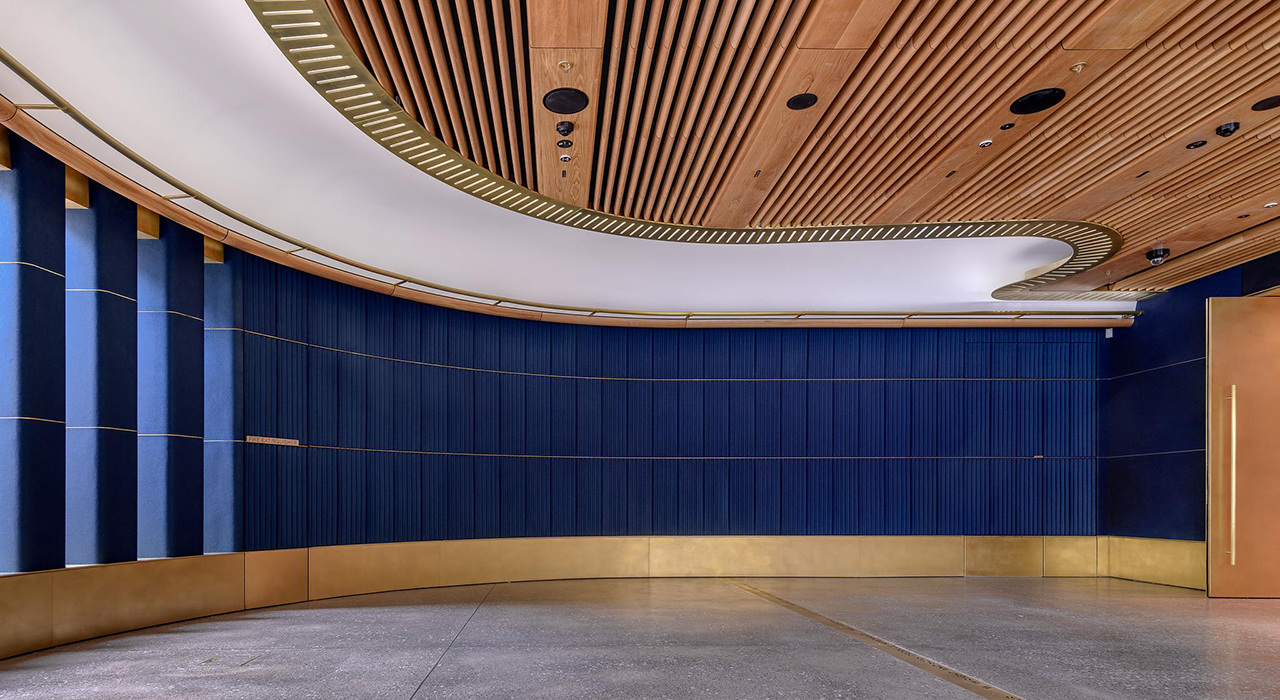
The shape and size of an auditorium can impact its acoustics. By altering room dimensions and the materials used in construction, you can dramatically improve sound quality. For instance, curved walls can help distribute sound more evenly, while angled surfaces can prevent sound waves from bouncing back and forth.
Implementing Sound-Absorbing Materials
From plush, acoustic rugs and carpets to heavy curtains, sound-absorbing materials work by trapping sound waves and preventing them from reflecting into the room. Acoustic floor rugs can reduce impact noise and absorb lower frequencies, while heavy curtains can dampen higher frequencies and block sound from entering or leaving the space.
Room Shape, Materials, and Layout
Think of these elements as the backstage crew of acoustics. They might not be in the spotlight, but they play a vital role in the performance. The shape of the room can focus or scatter sound waves, depending on its design. Convex surfaces, for example, help disperse sound evenly, while concave surfaces might focus sound to a specific point, causing echoes. The choice of materials—whether reflective like glass or absorptive like fabric—affects how sound behaves.

Acoustic Treatments for Auditoriums
At Unika Vaev, we offer a wide range of acoustic products – from acoustic panels to auditorium ceiling baffles to lighting options in a wide range of NRC ratings to prioritizing eco-friendly products, we have plenty of decorative and effective options!
- Acoustic Panels: Perfect for absorbing mid to high-frequency sounds, acoustic panels keep auditory experiences clear and crisp. They are designed to minimize echoes and reduce reverberation, ensuring that every sound is clear.
Available in a variety of sizes, shapes, and finishes, these panels can be integrated into any auditorium design, enhancing both the acoustics and aesthetics of the space.
- Ceiling Baffles: Ceiling acoustics are strategically placed to absorb sound from all directions, significantly reducing unwanted echoes and enhancing sound clarity. Acoustic ceiling baffles and panels are especially effective in large auditoriums, concert halls, and theaters where controlling sound from above the stage can be challenging.
Their sleek design allows them to blend in with the existing architecture while providing exceptional acoustic benefits.
- Sustainable Products: In today’s world, sustainability is more important than ever, and our range of eco-friendly acoustic solutions proves that you don’t have to compromise on performance to be kind to the planet. They are designed to meet the highest standards of environmental responsibility while delivering outstanding acoustic performance.

Design Your Perfect Environment
Enhance your auditorium’s sound quality and create a harmonious space with our unparalleled acoustic solutions. With years of experience in the acoustics industry, our team understands how to improve acoustics in a large room and utilizes their knowledge to tackle even the most complex noise challenges. From the initial consultation to custom acoustic solution design plans to the final installation, we provide ongoing support to ensure your project runs smoothly.
Ready to make your auditorium sound as stunning as it looks? Reach out to our team at Unika Vaev for a consultation and to ensure your auditorium space hits all the right notes. With our expertise in auditorium acoustic panels, ceiling baffles, and sustainable products, we’re ready to turn your auditorium into an acoustic masterpiece.